The Building Lot
Many interesting plants are found on our new property. These are found on the portion of land on which we will be building.
 |
| Purple Trillium (Trillium erectum) This gorgeous flower has three large leaves etched with an amazing webbing. The flower is reddish and is said to have a horrible stench. The plant, a relative to the lily, grows in rich soil. |
 |
| Wild Ginger (Asarum canadense) This is not the same root found in many Asian dishes; however, bruising the leaves release a similar scent. I was stunned when I first saw this carpeting areas of our land. It makes a beautiful ground cover. |
 |
| Wild Ginger (Asarum canadense) This is the flower found beneath the leaves of the Wild Ginger. It may not be the most beautiful flower, but I like it. This grow wild in rich wooded areas. We are lucky to have a lot of it. |
 |
| Wild Leeks; Ramps (Allium tricoccum) These edible delicacies run rampant (shameless pun) over our property. In fact, each spring brings groups of people in search of this lily relative. Unfortunately, ramps fall victim of over-foraging. The bulbs have a strong onion-garlic flavor; the leaves have the same yet more delicate flavor. |
 |
| Trout Lily (Erythronium americanum) These crane their little necks near the wild leeks, as they also love rich soil. We have also found them in the sandy areas of the woods near the river. They pop up early spring (much earlier this year). |
 |
| Spearmint (Mentha spicata) This was sold to me as spearmint. It doesn't grow wild, but it will surely take off. I planted it next to a sycamore tree with which I am in love. Ideally, it will grow around the tree each year. |
 |
| I have no idea what this is. At first, I thought it might be a wild bleeding heart because many dangled the way they should, but the leaves are completely different. I can't seem to find it in my Audubon Society field guide. If anyone can identify this, feel free to comment. |
Field Plants
I didn't take many photos of the flowers in the field. Because the field is perfect for farming, most of the field will be plowed, but we've discussed saving sections for the wild flowers.
 |
| Ragged Robin (Lychnis flos-cuculi) I fell in love with these. These are part of the carnation family. They are sprouting up here and there. The photograph does not do the vibrant color justice.
Most of our visit was spent planting some herbs in the field. We planted them along a ledge that leads down to the river. The herb garden will edge a path we've beaten down to make way into the woods and then the river.
|
 |
| My husband waters freshly planted herbs. Notice that the rive has eroded this slopping ledge. Eventually, some strong rooted plants will need to tie in this area to protect it from future damage. |
 |
| Thyme (Thymus vulgaris) This was sold as Oregano thyme. Although, I cook with thyme often, I don't know the difference, so the latin may be wrong. |
 |
| Rosemary (Rosmarinus officinalis) |
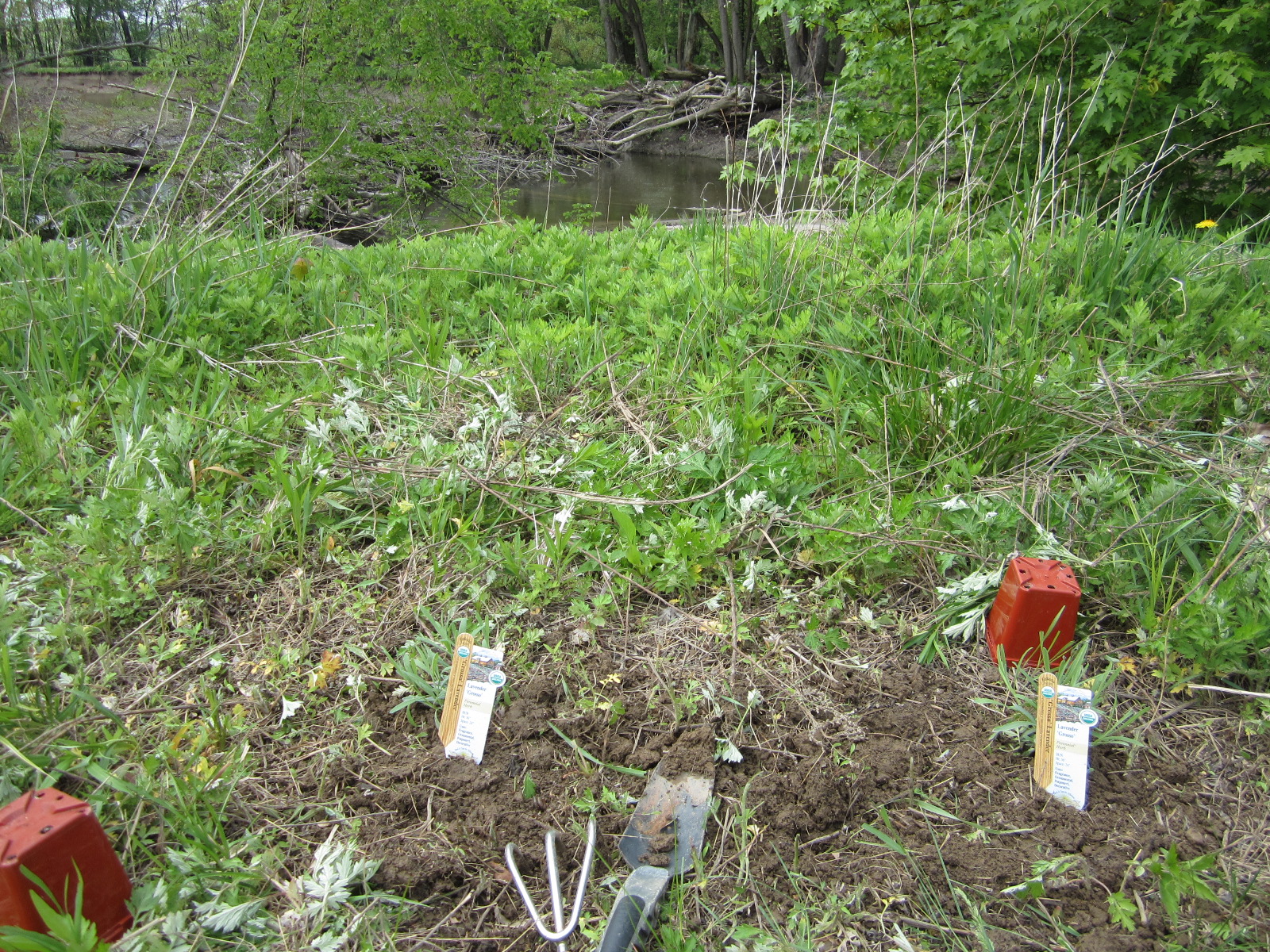 |
| Grosso Lavender (Lavendula x intermedia Grosso) I would love a whole field of lavender. These are supposed to be cold hardy. I think they will pop up again next year. Wouldn't it be cool if they ran down the ledge? |
Plants Found in the Woods
 |
| Blue Cohosh (Caulophyllum thalictroides) What a neat plant. It grows at the edge of the woods on the field side. It reaches my hips and looks as if it belongs in a garden. We missed its flowering stage, and I don't recall seeing the blue berries. |
 |
| When it rains, the river overflows into the woods. This low lying area holds the water throughout the year. I know it is a breeding ground for mosquitoes, but it is gorgeous. The overgrowth of ferns was the reason for the photo, but this water is the reason for the ferns. |
 |
| Ostrich Fern (Matteuccia struthiopteris) Top view. The ostrich fern is your basic fiddlehead fern. This is the one found in stores as an early spring delicacy. |
 |
| Ostrich Fern (Matteucccia struthiopteris) So far, the ferns, which are growing throughout the woods, reach my waist. I am willing to bet that they are chest height by summer. |
 |
| Bur Cucumber (Echinocystis lobata) Early in the spring, we noticed two leaves erupting from the ground that reminded us of squash. I'm guessing on the safe side because it seems to be growing wild. This plant should bear a prickly fruit that resembles a cucumber. It is not edible. |
 |
Back to the Trailer
Last fall, some close friends bought me bulbs for my birthday. I don't know how they knew, but daffodils and hyacinths are my favorites. They grew beautifully this year. They will find a permanent home on the river property as soon as I can replant them. So that I can find them after the leaves die down, I marked their locations with these popsicle sticks.

Well, we are working our way toward breaking ground for construction. I hope you continue to follow the progression.


